Stepping up…

Having just been successful as an internal candidate for Head of Department I thought it may be useful to share some of my thoughts regarding what made my application and interview successful, however reliable they may be!

I am going to attempt to be as concise as possible; if people would like to comment and discuss some of these points it would be great.

  • Be true to yourself.
    • Be honest about weaknesses since your interviewers in all likelihood know you well anyway.
  • Do not shy away from making clear what changes should be made.
    • In all cases there will be.
  • Strive to lead by example in all areas as a classroom teacher.
  • Remember you are still a schoolmaster.
    • Yes, it is an academic role however everything feeds into it.
  • Being a HoD does not take you away from the kids!
    • This was something which made me hold off considering the role wrongly in years past since I was a head of year and I really value and enjoy getting to know the kids and being involved with them.
    • There are undoubtedly elements which fall independent of this however I intend to strive to know the students as I do now (as head of two year groups).
    • Doing this will help in supporting your staff with their teaching, behaviour management, etc as well as promoting your subject within the school.
  • Remember that data is only one aspect of progress measurement.
    • Lesson observation (done in the right spirit), work scrutiny, discussion with staff and students over time will feed into this.
  • Get across that you intend to make your department an example to others.
    • Quite simply, intend to make the department the best in the school.
    • How will your department be visible within the school (extra-curricular, outreach, exemplar).
  • Do not forget teaching and learning!
    • This is more important than the administrative parts of the role.
    • Keep on top of research and read widely and model good practice on a department level for the benefit of the whole school.
Testing testing…

Having read a multitude of books and research papers extolling the benefits of regular, low-stakes testing as well as spaced practice and interleaving I have been trialling a program of testing with several classes since September.

Regarding the ideas mentioned above, I would very much recommend the following article: Strengthening the Student Toolbox: Study Strategies to Boost Learning

Without wishing to repeat what can be found in books such as Make It Stick: The Science of Successful Learning by Peter Brown and Henry Roediger and What Does This Look Like In The Classroom: Bridging The Gap Between Research And Practice by Carl Hendrick and Robin Macpherson (I wholeheartedly recommend both of these – more in a future post),  I am going to go ahead and outline some benefits of doing this and then describe briefly how I have implemented these ideas.

Benefits

  • Supports long term memory
  • Motivational
  • Confidence building
  • Provides regular opportunities to revisit past topics

Implementation

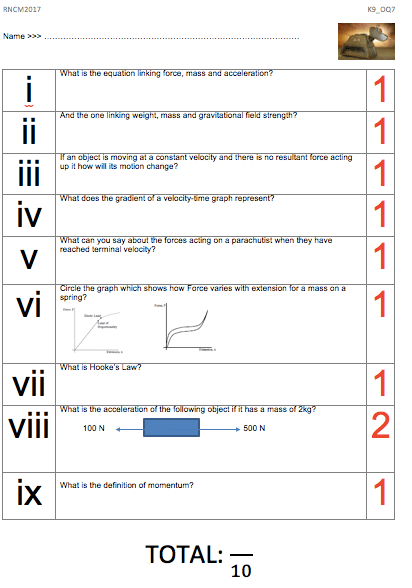
I have been using the format shown below. The name K9 I used originally to label the files (for ‘Knowledge 9’). The questions up this point have tested recall (of key equations and definitions) and straightforward short questions testing understanding and basic calculation.

Screen Shot 2017-11-14 at 22.55.37

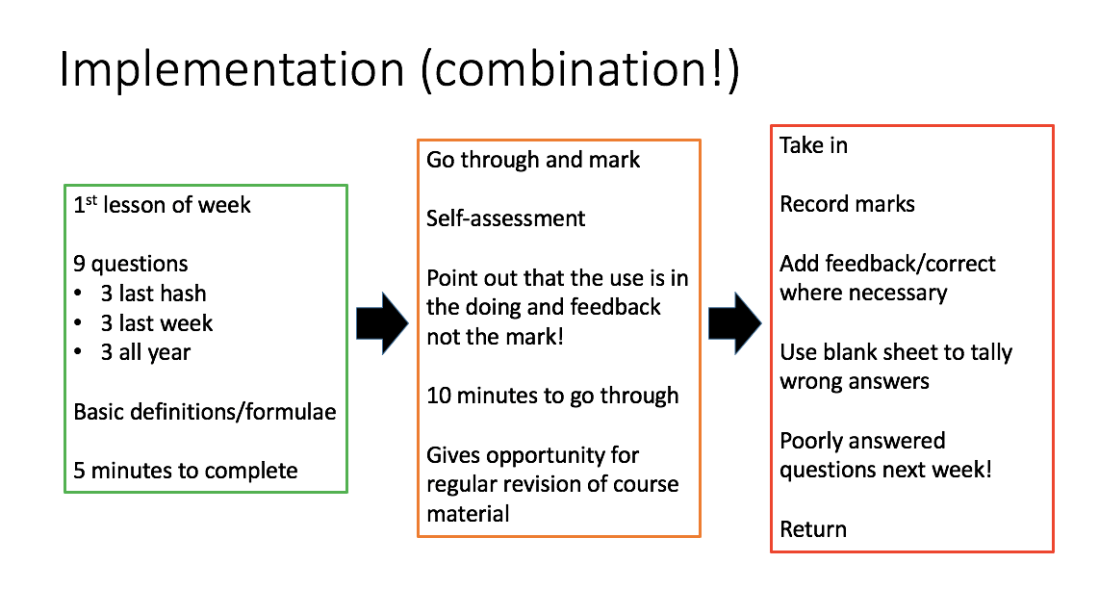
In the first lesson of every week the sheet is issued and students work quietly on it for the first five minutes of the lesson. I then take 5-10 minutes to go through the correct answers, using this as an opportunity to of course review material but also to get as many students involved as possible. I have found it a fantastically positive way to start the week.

I make clear to the students that:

  1. There is real benefit in struggling to remember. To get better at recalling information they have to practice the skill.
  2. I do not care about their mark but I do care about them having a go. I explain the hypercorrection effect – that committing to an incorrect response and then being corrected is more effective at stimulating learning than not providing any answer.

Below is a slide form a short session I ran for colleagues outlining my approach.

Screen Shot 2017-11-14 at 22.58.58

Developments

  • Since half-term I have been doing this with my other (Sixth Form) classes, however reading out the questions rather than providing a sheet.
  • I intend to try extending (or supplementing) this so that one week in three I set three longer problems which test application in the form of more detailed calculation/questioning.